How Much Should Fencing Cost Per Linear Foot?
Published by TradeIQ · Updated
Before you collect a single quote, it helps to know what fencing should cost per linear foot, so a dressed-up bid cannot slip past you. From what we see, most mainstream materials install for about $20 to $60 per linear foot, and a typical 150 to 200 foot yard lands somewhere between $4,000 and $12,000 once you add the gates. Those are wide ranges for a reason, and by the end of this page you will not be leaning on our range at all. You will be doing your own arithmetic.
Key takeaways
- No federal agency, standards body, or disclosed-methodology index publishes residential fence prices. Every per-foot number online, including ours, traces back to people who sell fences. Ours are our experience, and we say so.
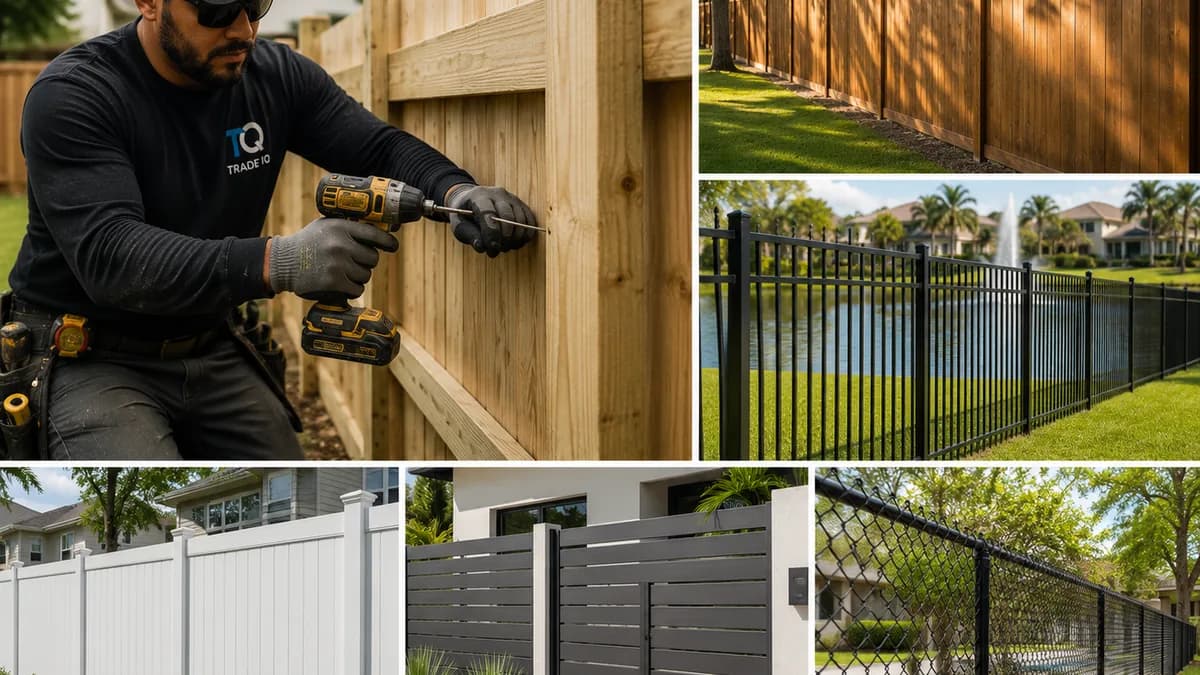
- From what we see, installed: chain-link $10 to $40, wood $20 to $50, vinyl $30 to $60, aluminum $25 to $75, composite $20 to $85, wrought iron $50 to $85. The ranges overlap heavily, so material tells you the neighborhood, not the address.
- Ignore the "national average" near $3,200. Over a 150-foot yard that is $21 a foot, which is chain-link money, and it makes an honest bid look like a ripoff.
- Labor is about half the job. A crew bills an effective $50 to $100 an hour in our experience, while the median fence installer is paid $23.07 an hour (BLS, May 2025). That gap is insurance, the truck, overhead, and profit, and a cash-only $30 an hour rate means one of those is missing.
- Gates, tear-out, and the permit are three separate line items. A walk gate is $175 to $450 installed, tear-out is $3 to $10 a foot, and your permit is whatever your city publishes, from about $25 to just over $100.
- Do not judge your bids against an average. Measure your footage, multiply by your material, adjust for your ground, add the three line items, then judge the bids against that number and against each other.
Start with the part nobody else will tell you. Nearly every fence price on the internet is published by a company that installs fences, or by a directory that sells your contact details to companies that install fences. That includes the big cost guides you have already read. We do not sell you a fence and we do not sell your information, but we still learned our numbers on job sites, so the ranges below are our experience, not a statistic. We are going to say that out loud every time we hand you a number, and then we are going to show you how to check us.
There is no neutral source for fence prices. That matters.
We went looking for a government agency, a standards body, or any index with a published methodology that tracks residential fence prices. There is not one. Not the Bureau of Labor Statistics, not the Census Bureau, nobody. Eight cost sites agreeing with each other is not eight sources, it is one source and seven copies, because they all footnote each other in a circle. When you see a confident national average for fencing, ask who benefits from you believing it.
Here is the entire list of fence-cost facts that come from somewhere neutral:
- What the installer earns. The federal wage survey for fence erectors (BLS, May 2025) puts the national median at $23.07 an hour, about $47,980 a year, with the top ten percent of the trade at $33.66 an hour. That is a paycheck, not a price.
- What your city charges for the permit. Every jurisdiction publishes its own fee schedule, and it is a real, verifiable, local number. Denton, Texas charges $44 for a residential fence permit. Menifee, California charges $103, or $206 for a non-standard design. Bradenton, Florida is around $25.
- Whether you need a building permit at all. Under the model building code, a fence below 7 feet is simply not building-permit work. Most cities still want a zoning or fence permit, which is the small fee above, but you are not pulling a structural permit for a 6-foot privacy fence.
That is it. Three facts. Everything else you will read today, on this page and every other, traces back to somebody who sells fences. So use the ranges the way a tradesperson uses them: as a sanity check on the bids in front of you, never as the authority that outranks them.
Cost per linear foot by material
These are installed ranges, materials and labor together, for residential fences in 2026. They come from what we see quoted and built, and each one names what pushes it to the top or bottom of its band:
- Chain-link: $10 to $40 a foot. A standard 4 to 6 foot galvanized residential run sits around $15 to $20. Up: height, vinyl coating, heavier commercial-grade pipe, privacy slats. Down: shorter fence, plain galvanized, long straight runs. Does not apply if your HOA bans it, which many do.
- Wood, treated pine or cedar: $20 to $50 a foot. Basic pine privacy near $20, an average 6-foot job $30 to $35. Up: cedar over pine, 8-foot height, cap and trim, steel posts, a stained finish. Down: pine, 4 to 6 feet, dog-ear pickets, no finish. Does not apply to a rebuild that reuses good posts, which can land well under this.
- Vinyl (PVC): $30 to $60 a foot. A short picket about $30, a 6-foot privacy run $40 to $45. Up: tongue-and-groove privacy panels, tall or decorative styles, colors other than white, wind-rated panels. Down: shorter picket or rail styles, standard white, simple layout.
- Aluminum (ornamental): $25 to $75 a foot. A simple pool or rail fence starts near $25 to $30, most yards run $40 to $50. Up: height, heavier gauge, spear tops and decorative castings, pool-code spacing, powder-coat colors. Down: standard residential gauge, 4-foot height, straight runs.
- Composite: $20 to $85 a foot. A 6-foot privacy run is $40 to $60. Up: designer brands, wide boards, aluminum-reinforced rails, color-matched trim. Down: basic rail systems, standard colors. Watch this one: composite has the widest spread of any material, so a bid inside the range can still be a bad bid.
- Wrought iron: $50 to $85 a foot. Basic runs near $50. Up: custom patterns, tall security height, hand-forged work, on-site welding. Down: prefab panels. Does not apply to a true custom or restoration job, which is priced as fabrication, not as fence.
Notice how much the ranges overlap. A high-end chain-link can cost more than a basic wood fence, and a premium composite can run past wrought iron. Material tells you the neighborhood, not the address.
Where the money goes: materials versus labor
For a typical residential fence, labor runs about half the total, sometimes more when the ground fights back. That surprises people who assume they are mostly paying for lumber or panels. You are paying for the crew to dig, set, and hang almost as much as for the material itself. In per-foot terms, labor on a common wood or vinyl fence tends to land around $10 to $20 a foot, while chain-link is lighter and faster to hang, closer to $5 to $10.
Now the two numbers people confuse. In our experience a crew bills out at an effective $50 to $100 an hour, and that is our figure, not a published one. What an installer is paid is a published figure: $23.07 an hour at the national median. The gap between the two is not greed. It is payroll burden, liability and workers comp insurance, the truck, the auger, the trailer, the fuel, the warranty they have to come back and honor, the overhead, and the profit that keeps the company alive long enough to honor it. That gap is normal and every legitimate contractor carries it. It is also exactly why "I will do it for $30 an hour, cash" is a warning and not a deal: at that rate, something in the list above is not being paid for, and it is usually the insurance.
What drives your price up or down
Two yards with the same 180 feet of the same material can price very differently. Each of these moves the per-foot number, and each is a fair thing for a contractor to charge for:
- Height. Taller fences cost more per foot, not just more overall. Going 4 to 6 feet adds roughly 10 to 25 percent a foot. Going 6 to 8 feet adds another 20 to 50 percent, because 8-foot privacy needs longer posts, deeper holes, an extra rail, and more boards.
- Post setting and concrete. Deeper footings, tighter post spacing, and fully concreting every post add a few dollars a foot. A hard frost line forces the holes deeper whether anyone likes it or not, so northern jobs sit higher than southern ones on this line alone.
- Terrain. A sloped, rocky, or tightly landscaped yard adds about 10 to 30 percent to the total job for the extra digging and the stepped or racked panels. That percentage is of the whole job, not just the labor line, because slope costs you material too.
- Grading. If your yard needs actual grading, that is its own project, with its own contractor, its own equipment, and its own quote. Do not let it get folded into a fence bid as a vague allowance. Get it priced separately and in writing before you sign anything.
- Layout. Every corner and short run adds a post, and each extra post can add $50 to $200. A chopped-up yard with six corners costs more per foot than one long straight run of the same footage.
- Soil and rock. Hardpan, bedrock, or root-choked ground can force hand-digging or a rock auger, pushing labor to the top of its range and adding 10 to 20 percent. Nobody can see this from the street, and that is the reason any contractor worth hiring walks the line before he prices it.
- Access. If the crew cannot get a truck or a machine into the backyard, every post, bag of concrete, and panel is carried by hand. That is real time and it belongs on the bid.
The three line items that ride on top
Your per-foot rate covers fence. It does not cover these, and a thin quote keeps them vague on purpose. Insist on seeing all three broken out as their own lines. If a bid comes in far under the others, this is usually where the missing money went, and our guide to the red flags in fence quotes walks through what a lowball number tends to leave out.
1. Gates
Every opening is an add-on. From what we see, a gate adds somewhere between $150 and $600 over a plain panel of the same fence, and here is what that looks like installed:
- Basic walk gate, wood or chain-link: $175 to $450 installed. Up: a wider opening, a self-closing latch, heavy-duty hinges, a gate that has to hold a dog in. Down: a standard 3-foot opening on an existing post line.
- Vinyl walk gate: $300 to $400 installed, because the frame has to be reinforced or it sags.
- Double drive gate for a vehicle: $400 to $900 in wood, $800 to $1,200 and up in vinyl. Up: span, wheel or cane bolt hardware, steel frame.
- Decorative aluminum or pool gate: $175 to $400 installed. Up: pool code, which requires self-closing and self-latching hardware and is not optional.
- Automated gate: $800 to $2,000 and up. This is an electrical job attached to a fence, and it should be quoted like one.
If you see a walk gate quoted at $75 or $100 installed, that is the price of the hardware kit, not the price of hanging it. A crew that bills $50 to $100 an hour cannot frame, hang, plumb, and latch a gate in under an hour with zero material and zero profit. Somebody is going to make that money back somewhere, and it will not be a place you enjoy.
2. Tearing out the old fence
Removing and hauling away what is there now runs about $3 to $10 a foot, so figure $500 to $1,500 across an average backyard. Up: concrete-set posts, tall fences, chain-link buried in a hedge, dump fees in your county. Down: a short fence, wood posts in dirt, or you pulling it yourself over a weekend. It climbs to $20 a foot for tall or heavily concreted fences. Does not apply if there is nothing to remove, and if there is nothing to remove, no bid should be charging you for it.
3. The permit
This one you can verify in about two minutes, which makes it the most honest number on this page. Search for your city plus "fence permit fee schedule." You will find an actual published fee for the actual jurisdiction that governs your actual yard. Denton, Texas charges $44. Menifee, California charges $103, or $206 for a non-standard design. Bradenton, Florida is around $25. The fee is usually flat and is not tied to your footage. A 6-foot privacy fence sits below the model code's building-permit threshold, but most cities still require a zoning or fence permit, so do not skip the search. And make the bid say who files it and who pays it, because skipping a permit can buy you a fine or a stop-work order after the posts are already in the ground.
Got a quote and want to know if the number is fair?
Knowing the range is step one. Knowing whether your exact bid is fair for your material, your height, and your yard is step two. Run the quote past a TradeIQ installer who is not in the running for the job, and you will hear where the number ought to sit and whether yours reads as square, steep, or quietly missing a step. Nothing in that read is angling for your contract.
What a whole yard runs
Put the per-foot number against a real yard. A 150-foot yard runs about $3,000 to $9,000, with chain-link at the bottom and vinyl, composite, or ornamental at the top. A 200-foot yard runs about $4,000 to $12,000 in wood or vinyl, with basic chain-link closer to $2,000 to $6,000 and premium wrought iron or composite able to push past $12,000. Add gates, tear-out, and the permit on top of every one of those figures.
You will not find a national average on this page, and that is deliberate. The averages floating around, somewhere near $3,200, are published by fence sellers and lead brokers, and they do not survive contact with their own math. Spread $3,200 over a 150-foot yard and you get $21 a foot, which is chain-link money, and yet it gets labeled a mid-range wood or vinyl fence. Those averages are dragged down by tiny jobs and partial replacements. They are not an average of the thing you are buying. And a low, friendly average does real damage: it makes an honest $6,500 bid look like theft and walks you straight toward the lowball, which is the one bid you should actually be scared of.
Rules of thumb that hold up, and ones that will burn you
Fence folklore gets passed around like scripture. These few are close enough to be useful:
- "About $20 to $60 a foot installed." Holds up for mainstream wood and vinyl at normal heights on a workable yard. It stops holding at 8 feet, on a slope, or in designer composite.
- "Chain-link is roughly half the price of wood." Close enough to reason with, though a high-end coated chain-link can overlap a low-end wood fence.
- "Labor is about half the job." That matches what we see, and it is why a bid that undercuts everyone by thousands is almost always cutting the crew, the insurance, or the depth of the holes.
And these will steer you into a bad decision:
- "A basic backyard fence is $3,000 to $5,000." Run it: $3,000 to $5,000 across a 150 to 200 foot yard is $15 to $33 a foot. That is chain-link money, and people repeat it while picturing wood. It is the folklore version of that fake national average, and it is the single fastest way to talk yourself into believing the lowball is the honest bid.
- "Ten dollars a foot for any fence." Only realistic for the cheapest chain-link or barbed wire. Most privacy options start closer to $25 to $30.
- "Just multiply your footage by $25." Fine for a mid-range wood fence on flat, clear ground with no gates. It ignores material, gates, tear-out, and your dirt, and a composite or wrought iron run can cost two to three times that.
- "Eight feet is only a little more than six." Not true. An 8-foot privacy fence often runs 20 to 50 percent more per foot for the longer posts, deeper holes, extra rail, and extra boards.
Do the arithmetic yourself
This is the part that actually protects you, and it takes about fifteen minutes. Do not judge your bids against a national average. Judge them against your own yard and against each other.
- 1Measure the real footage. Walk the line with a tape or a measuring wheel, or trace it on a satellite map. Never work off a guess, yours or a bidder's. Write the number down.
- 2Pick your material and your height, then multiply. Take the middle of that material's range from the list above and multiply it by your footage. That is your fence-only baseline. Example: 180 feet of 6-foot wood at $32 a foot is $5,760.
- 3Adjust for your ground. Sloped, rocky, or tight-access yard? Add 10 to 30 percent to the whole baseline. Flat, clear, straight, with a side gate wide enough to drive a trailer through? Stay at the bottom of the range.
- 4Add the gates as separate dollars. One walk gate, $175 to $450. A drive gate, $400 to $1,200 depending on material. Do not bury them in the per-foot rate.
- 5Add tear-out if there is an old fence. Your footage times $3 to $10, more if the posts are in concrete.
- 6Add the permit. Look up your city's actual published fee. It is probably somewhere between $25 and a bit over $100, and it is a fact, not an estimate.
- 7Now line the bids up against your total and against each other. You are looking for a bid that is close to your arithmetic and that shows the same line items you just added. A bid that is far under the pack is not a bargain you found. It is a question you have not asked yet.
Do that and you are no longer trusting anyone's average, including ours. You are holding a number you built out of your own footage, your own dirt, and the fee schedule your own city publishes, and that is the only fence price on the internet that was not written by somebody who wants to sell you a fence.
The one price on the internet nobody published to sell you something
This whole page was an argument that the numbers on it are not good enough. We refused to print a national average, told you our own ranges are just what we see and not a statistic, and sent you to your city's fee schedule for the only figure anybody actually publishes. That is as far as writing can take you, because none of it knows your slope, your dirt, or the oak root sitting where post nine goes. Send the quote and your footage to a TradeIQ installer. He has priced yards like yours, he is not bidding on this one, and what he tells you is worth more than any range because it is finally about your fence.
A Written Review of the bid is the right fit here.
Get an unbiased expert reviewFrequently asked questions
- How much does fence installation cost per linear foot?
- From what we see on residential jobs in 2026, figure about $10 to $40 a foot for chain-link, $20 to $50 for wood, $30 to $60 for vinyl, $25 to $75 for aluminum, $20 to $85 for composite, and $50 to $85 for wrought iron, installed. Most mainstream wood and vinyl jobs sit in the $20 to $60 band. Those are our field ranges, not a published statistic, because no neutral body tracks fence prices. Where you land inside a range depends on height, your soil and slope, and how many corners and gates the layout has.
- What is the cheapest fence to install?
- Chain-link, by a clear margin, at roughly $10 to $40 a foot installed and often $15 to $20 for a standard 4 to 6 foot residential run. It is light, fast to hang, and cheap in material. The tradeoff is looks and privacy, and plenty of HOAs will not allow it. If you want a solid privacy fence on a budget, basic pressure-treated pine at about $20 a foot is the next step up.
- How much does a privacy fence cost?
- A 6-foot privacy fence, the most common request, runs about $25 to $60 a foot installed depending on material, with pine at the bottom and vinyl or composite at the top. On a 150 to 200 foot yard that is roughly $4,000 to $12,000 for the fence itself, before you add gates, tear-out, and the permit. Going to 8 feet tall adds another 20 to 50 percent per foot for the longer posts and extra material, so it is a real jump and not a small upgrade.
- How much does a chain link fence cost per foot?
- Installed chain-link runs about $10 to $40 a foot in our experience. A standard 4 to 6 foot galvanized residential fence usually lands around $15 to $20. The top of the range is 8 to 10 foot commercial-grade pipe or vinyl-coated systems, and privacy slats push it up as well. It is the most affordable common fence because the material is light and the install is quick.
- How much does a fence permit cost?
- There is no national fence permit fee, so do not trust a range you read online, including this one. Look up your own city, because that is the only jurisdiction that governs your yard: search for your city plus "fence permit fee schedule." Real published examples: Denton, Texas charges $44 for a residential fence permit, Menifee, California charges $103 or $206 for a non-standard design, and Bradenton, Florida is around $25. The fee is usually flat rather than tied to footage. Fences under 7 feet are exempt from a building permit under the model code, but most cities still require a zoning or fence permit. Make sure your quote says who files it and who pays for it.
- What does a new fence cost for an average yard?
- For a 150 to 200 foot yard in 2026, a wood or vinyl fence typically runs $4,000 to $12,000, basic chain-link comes in around $2,000 to $6,000, and premium wrought iron or composite can top $12,000. Gates, tear-out of the old fence, and the permit all sit on top of that. Be careful with the "national average" of around $3,200 that circulates online: it is published by companies that sell fences, it works out to about $21 a foot on a 150-foot yard, which is chain-link pricing, and it is dragged down by small jobs and partial repairs. It is not an average of the fence you are actually buying.