How to Compare Roofing Contractor Quotes
Published by TradeIQ · Updated
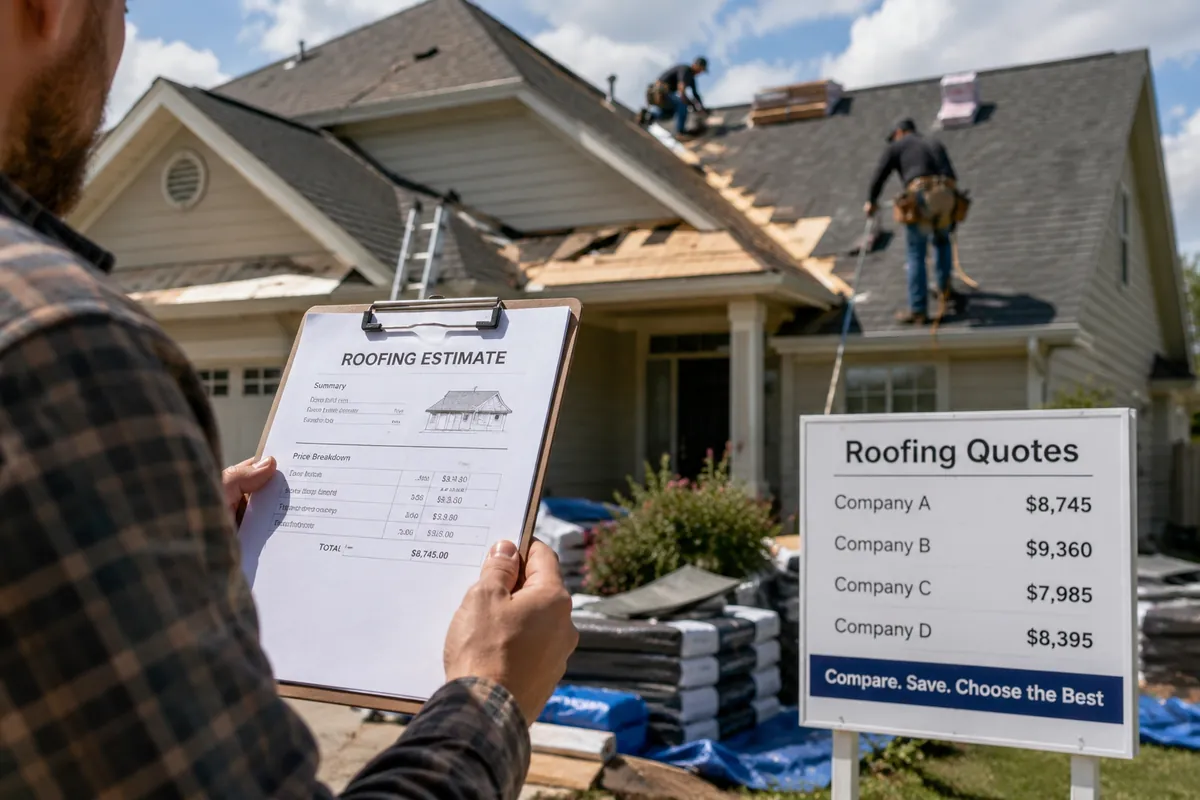
You’ve got two or three roofing quotes spread across the kitchen table, and the prices are hundreds, sometimes thousands, of dollars apart. Before you assume the cheapest one wins or the priciest one is a rip-off, understand what you are actually holding. A roofing quote is a bet. Every roofer who walked your property was silently pricing things he cannot fully see, and the spread between them is mostly a measure of how differently they bet. Here is how to read the bets.
Key takeaways
- Get three quotes, and make sure all three are bidding the exact same scope, or you’re comparing different jobs.
- A real estimate is itemized: tear-off, decking, underlayment, flashing, shingle line, ventilation, and warranty.
- Compare price per square, not just the bottom-line total.
- The cheapest bid is often the one leaving out flashing, tear-off, or a permit.
- If a bidder cites the “25% rule” to justify a bigger job, make him name the code section. It is a Florida rule, and Florida narrowed it in 2022.
How many roofing quotes should you get?
Get three. Two doesn’t give you enough to spot the outlier, and once you’re past three or four you’re mostly burning your own time and annoying good contractors who can tell they’re bid number nine. Three gives you a low, a high, and a middle, and the middle is often where the honest number lives.
One catch: three quotes only help if all three are pricing the same work. If they’re not, you are not really weighing prices. You are weighing different projects that each happen to sit on a roof.
The three things every roofer had to guess at
Nobody who bid your roof could see all of it. Three things were hidden from every one of them, and each roofer had to put a number on them anyway. That is where your spread comes from.
The wood underneath is the first. Not one of them knows how much rotted decking is under your shingles, because the only way to find out is to tear the roof off, and nobody tears a roof off to write an estimate. The second is how hard your house is to work on. Whether a dump trailer can back near the eave or has to sit at the curb. Whether bundles ride up on a conveyor or go up on a man’s shoulder, one at a time, past your pool. Whether the pitch is gentle enough to walk or steep enough that the crew has to rig staging before anybody touches a shingle. The third is what is stacked up there already, because a second layer doubles what comes off and doubles what goes in the dumpster.
Here is the part that matters. A roofer can price those three honestly and hand you a bigger number, or he can price them optimistically, win the job, and find them on tear off day when you have no roof and no say in the price. Both bids look the same on paper. They are not the same bid. So when you see a gap, do not ask who is cheapest. Ask who put the unknowns in writing.
What a complete roofing estimate should include
A real estimate breaks the job into line items so you can see what you’re actually paying for. A single line that reads “New roof: $12,000” tells you nothing and hides everything. Look for each of these spelled out:
- Tear-off and disposal: the count of existing layers stripped, with haul-away included
- Decking: an inspection, and a set price per sheet if the plywood underneath turns out rotted
- Underlayment: synthetic or felt, plus ice-and-water shield at the eaves and valleys
- Flashing: new drip edge and new flashing at chimneys, walls, valleys, and every pipe and vent
- Shingles: the actual brand, line, color, and the wind and warranty rating, not just the word “architectural”
- Ventilation: ridge vent or other intake and exhaust work
- Size and rate: number of squares (1 square = 100 sq ft) and the price per square
- Cleanup: magnetic nail sweep, debris removal, and the permit cost
- Warranty: the workmanship warranty length, stated separately from the manufacturer warranty
Reading the price per square
Take the bid total and split it across your squares, and you get the price per square. That’s the number that lets you compare a bid on a small ranch against a bid on a big two-story, because it strips out roof size. If one roofer’s price per square is way off the others, that’s not automatically a deal or a scam. It’s a question to ask.
How to compare roofing quotes, line by line
Here’s the actual method. It takes about twenty minutes and saves you from the most common roofing mistake there is: picking a number instead of a job.
- 1Line the three estimates up side by side, using a simple spreadsheet or the columns from a comparison worksheet.
- 2Match the scope first. Same tear-off depth, same underlayment, same flashing plan, same ventilation. Normalize the work before you look at any price.
- 3Compare price per square, not the bottom-line total.
- 4Note what’s missing. A bid with no flashing line, no permit, or no decking allowance isn’t cheaper. It’s incomplete, and the difference shows up as a change order later.
- 5Check the two warranties separately: workmanship and manufacturer.
- 6Only now, after all of that, look at the totals.
Red flags in a low roofing quote
A rock-bottom price is not proof of a scam by itself. Still, when one bid drops well beneath the rest, it is usually because a line on this list got quietly dropped:
- No tear-off: going over the old shingles to save money, which adds weight, traps heat, hides rot, and shortens the new roof’s life
- Reused flashing: recycled flashing is where a fresh roof most often starts to leak
- Vague materials: “architectural shingles” with no brand or line named
- A large deposit, or a discount for paying cash
- No written scope, and no permit line at all
When one bidder claims code forces the bigger job
Here is a scope gap that wears a disguise. One roofer bids the repair you asked for. Another says code will not let him stop there, cites the “25% rule,” and bids a full tear off. Those two bids are now impossible to compare, and the second one is quoting a rule that almost certainly does not apply to you: it belongs to Florida, and Florida narrowed it in 2022. Our guide to why roofing quotes differ walks through what it actually says.
So treat it like any other scope difference. Ask him to name the code section and show you where your building department enforces it. If he can, the bigger job is real and everyone else needs to rebid it. If he cannot, you just found out which of your three bids was padded, and you found out before you paid for it.
When it makes sense to negotiate
Roofing isn’t a flea market, and leaning on a good contractor to shave corners just to hit a number brings back the exact problems this guide helps you dodge. But when two solid bids land close and one sits higher, it’s fair to ask that roofer to explain the difference or match the scope.
Timing is worth knowing, and most of what you have read about it is wrong. Federal employment figures show roofing crews are still flat out through October. The real lull is January and February, when the industry sheds about ten percent of its workforce. That is when a roofer has an empty calendar and a reason to want your job. We will not promise you a discount for waiting, because nobody publishes roofing prices and anyone who tells you winter is cheaper is guessing. What we can tell you is that a hungry crew answers the phone.
Can’t tell which bid to trust?
Hand all three to a TradeIQ pro. He has written bids like these for twenty years, he is not bidding yours, and he can tell you which roofer priced the unknowns and which one buried them.
Have a real roofer read your bids before you sign
Upload your roofing quotes. The pro who reads them has stood on roofs like yours and knows what the tear off is going to find, and because your job is not his job, he has no reason to shade the answer.
Best fit: a Written Review. You’ll get a clear, honest breakdown back, usually within a day.
Get an unbiased expert reviewFrequently asked questions
- How do you choose between two close roofing bids?
- Once both cover the same scope, compare the price per square instead of the totals, then weigh the warranties and the crew’s references. If the two are neck and neck, ask the higher one to justify the gap. The bid that spells out flashing, decking, and a permit usually beats the one that stays vague.
- How many estimates should I get for a roofing job?
- Three is the sweet spot. Two doesn’t give you enough to spot an outlier, and more than three or four rarely changes the picture while eating your time. The key is that all three quote the same scope of work.
- How do you compare roof estimates?
- Match the scope first (tear-off depth, underlayment, flashing, and ventilation), then compare price per square rather than the bottom-line total, then check the workmanship and manufacturer warranties separately. A cheaper bid that skips flashing or a permit isn’t actually cheaper.
- How do you negotiate a roofing quote?
- Get competing bids on identical scope, then ask a higher bidder to explain or match the gap. Don’t push a roofer to drop tear-off or flashing to win the job; one who agrees is telling you who they are. If you can wait, the industry’s quietest stretch is January and February, so that is when a crew is likeliest to have room for you.
- What is the cheapest time of year to get a new roof?
- Nobody publishes roofing prices, so treat any confident answer with suspicion, including the common one that late fall is slow. Federal employment data says otherwise: roofing stays busy through October and bottoms out in January and February. A crew with an empty February calendar has every reason to compete for your job. The worst time to buy is the few weeks after a big hailstorm, when everyone in the county needs a roof at once.