How to Find and Fix a Roof Leak Yourself
Published by TradeIQ · Updated
A water stain on the ceiling almost never sits right under the hole. Water sneaks in up high, runs down the decking or a rafter, and drips where it feels like it. So finding a roof leak takes a little detective work, and fixing one is very doable once you know where to look. Here is how a roofer traces a leak to its real source, the two repairs you can finish yourself, and the ones worth paying for.
Key takeaways
- The leak is almost always higher up the roof than the stain on your ceiling.
- Check the penetrations first: chimneys, vent pipes, skylights, dormers, and valleys.
- The hose test works if you go slow and soak one small section at a time.
- A cracked pipe boot and a lifted shingle are both a morning of work, on a dry roof you can stand on.
- Flashing, cement, and tarps buy time. They do not replace a real repair.
- Roofs were the primary source in 165 fatal construction injuries in 2022, ladders in 90. For injuries people survive it flips: 11,600 from ladders against 2,800 from roofs. The ladder hurts more people. The roof kills more of them.
- Chimneys, valleys, low-slope roofs and any steep or wet pitch are a call-a-pro job.
Start where leaks actually happen
Most leaks start at something that pokes through the roof, not out in the open shingles. Check these spots first: chimneys, plumbing vent pipes, skylights, dormers, and the valleys where two roof planes meet. The flashing and sealant around those areas fail long before a shingle field does.
How to find the leak from inside
Grab a flashlight and go into the attic during or right after rain. Follow the water uphill. The wet spot on the underside of the decking is usually higher than the stain on your ceiling, because water runs down the wood before it drips.
- 1Look for dark, stained, damp, or moldy wood on the decking and rafters.
- 2Trace the wettest path up to the highest point it starts.
- 3Mark that spot. If there is an actual hole or you can see daylight through it, push a wire up so you can spot it from the roof later. Do not make a new hole to mark one.
The hose test, for a dry day
If it is not raining, you can make it rain. Have one person watch the attic while another runs a garden hose on the roof. Work from the ladder or from the ground with a spray wand, because nobody should be standing on a roof they are actively wetting. Start low at the eaves and soak one small section, about four feet wide, for a few minutes. If nothing shows inside, move up a few feet and repeat. Go slow. Moving the hose up too fast is how people miss the spot.
How to stop a leak right now
These buy you time until a proper repair. They are not the fix.
- In the rain, slide a piece of flashing or heavy plastic under the shingle course above the hole to divert the water.
- Over a small hole or a cracked pipe boot, use roofing cement or a peel-and-stick patch.
- For a bigger area, run a tarp up and over the ridge and weigh it down so wind cannot get under it.
All three of those put you on a wet roof, which is the one place this page keeps telling you not to go. If the pitch is slick, the tarp waits. Inside, move what you can out from under the drip, and if the ceiling is bulging, put a bucket down and punch the low point with a screwdriver so the water comes out where you choose instead of bringing the whole thing down at once. Drywall is cheap. Nothing else about this is.
What about Flex Seal and spray products?
They can slow a small leak for a while, but they hide the real problem and make a proper repair messier later. Fine as an emergency stopgap on a rainy night. Not a real fix.
The two repairs you can actually finish
Both of these want the same conditions: a dry roof, a pitch you can stand on without sliding, and some sun on the shingles first. Cold shingles crack when you bend them, and a shingle you cracked getting to the repair is now a second leak.
Replacing a cracked pipe boot
This is the most common leak on a shingle roof and the most satisfying one to kill. The rubber collar around a plumbing vent perishes years before the shingles do, splits, and lets water straight down the pipe into the ceiling below. Boots are sized to the pipe, so measure the vent before you go to the supplier, or pull the old one first and take it with you.
- 1Break the seal on the shingles covering the top half of the old flange. A flat bar slid under the tab lifts it without tearing it.
- 2Pull the nails holding the old flange down, then lift the whole boot up off the pipe.
- 3Slide the new boot down over the pipe. The top half of its flange goes under the course above, the bottom half sits on top of the shingles below. Water has to run over that joint and never into it, and getting that backwards is the reason a new boot still leaks.
- 4Nail the top corners of the flange, press the lifted shingles back down, and seal the tabs.
If you would rather not disturb the shingles at all, there is a retrofit collar that slips over the existing flange and seals to the pipe. It is a shorter job and a shorter life, but it is a real repair and not a smear of cement.
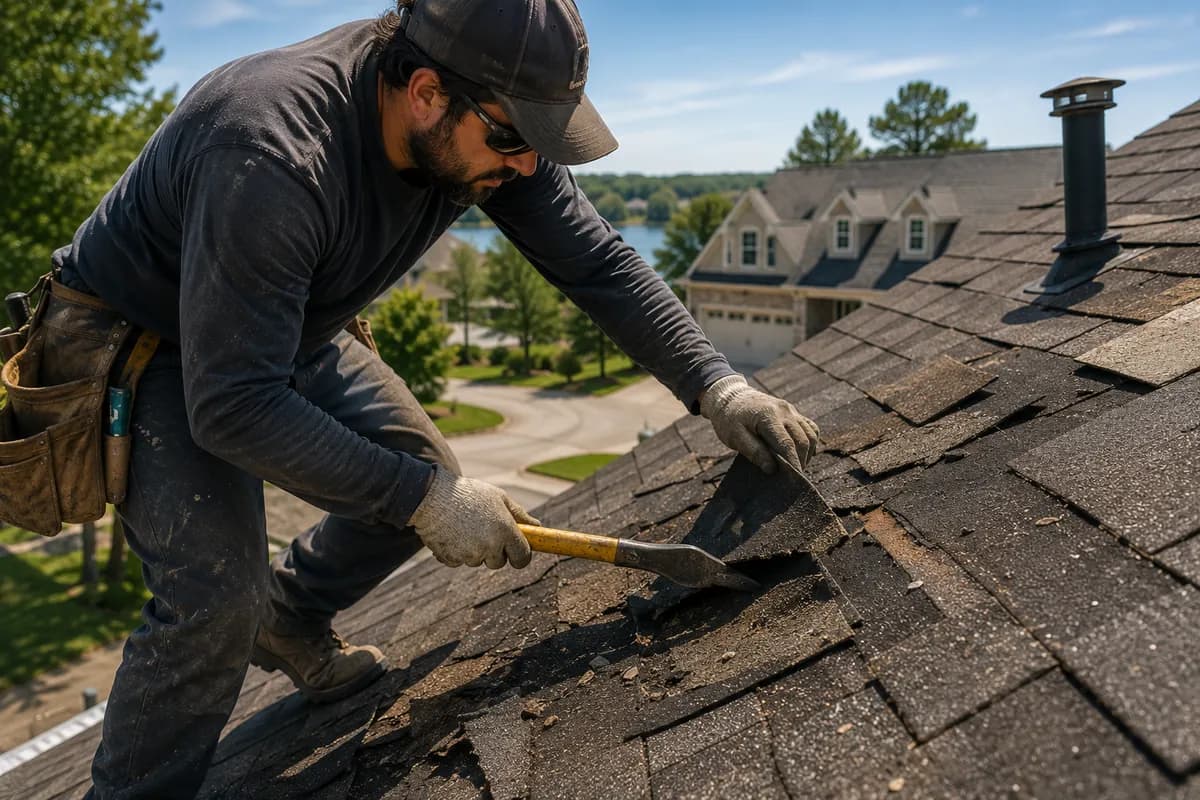
Replacing a lifted or broken shingle
Finding the shingle is the hard part of this one. Check the garage and the attic for leftovers from the last roof before anything else. If there are none, take a whole shingle to a roofing supplier rather than a big box store, and accept that a roof that has been in the sun for ten years will not match a fresh bundle exactly. On a back slope nobody sees, that is fine. On the front of the house, find that out before you start and not after.
- 1Lift the tab above the bad shingle and break its seal.
- 2Pull the nails along the nailing line, including the ones in the course above that pass through the shingle you are removing.
- 3Slide the old shingle out and the new one in, lined up with its neighbours.
- 4Nail through the same line, then seal down every tab you lifted.
Anything past those two, and past the flashing you can reach without walking the roof, is where the job stops being a morning and starts being someone else’s trade.
When to stop and call a pro
The roof is what kills people. The ladder is what hurts them, and the federal numbers split that cleanly. CPWR, the construction research center, examined fatal and nonfatal injuries in construction by what caused them. In 2022, roofs were the primary source in 165 fatal construction injuries and ladders in 90. Turn to the injuries people survive and it inverts: across 2021 and 2022, ladders were the source of 11,600 injuries bad enough to cost a worker days away from work, against 2,800 for roofs. And of every construction subsector CPWR broke out, roofing contractors lost the most people to falls, slips and trips in 2022, 100 of them.
Do not picture all hundred of those clipped to an anchor. The same report found that where an employer did no fall planning at all, the odds of workers using their protective equipment were 71 percent lower. These are people who are on roofs every day, and plenty of them were up there with nothing.
None of that makes the ladder the safe part. It is the thing most likely to hurt you today. Tie the top off, set the feet on something flat, and let it stick three feet past the edge. Then understand that the dangerous part starts when you step off it.
If the leak is around a chimney, in a valley, on a low-slope or flat roof, or anywhere you would have to walk a steep or wet pitch, that is a call-a-pro job. A low-slope roof is a different system with a different material and usually a different crew, and a shingle repair is not what it needs. If the decking under the leak has gone soft, you are into a repair or replace decision rather than a patch, and choosing the roofer who does it is its own piece of work.
One more thing, because the usual version of this is wrong. A shingle maker’s warranty does not carry a clause that voids everything the moment you touch your own roof. It carries a list of causes it will not pay for, and your boots and your tools are on that list. CertainTeed’s own warranty lists among the things it does not cover: "Damage caused by impact, including such things as tools, equipment or foot traffic." The promise a DIY patch really can cost you is the roofer’s own workmanship warranty, or a manufacturer system warranty that required a certified installer, because those are contracts with a person and they tend to say who is allowed up there. If you are not sure which you have, read what a shingle warranty actually promises before you climb.
Quick patch, or a bigger problem?
Send a TradeIQ roofer a few photos of the stain, and of the roof above it. He will tell you whether you are looking at a cracked boot and a tube of sealant, or water that has been sitting in the decking long enough to have turned into carpentry.
Ask before you climb
Read back what this page just told you to do. Buy a boot and a tube of sealant. Pull a few nails. Keep your money. Now notice who is telling you that, and who is not getting paid either way it goes. Plenty of roofers publish honest advice, and a good one will tell you when a leak is not worth a truck roll. The trouble is that you cannot tell which kind you called until after you have called, and the man who quotes the carpentry has every reason to find carpentry. Send your photos to someone with no stake in the answer and you get one of two: a cracked boot and half an hour of your Saturday, or water that has been sitting in that decking for two winters and is carpentry now.
Good fit: a quick Phone Call, or send photos over for a Written Review.
Get an unbiased expert reviewFrequently asked questions
- Can I fix a roof leak myself?
- Often, yes, if it is a small, reachable problem like a cracked pipe boot or a lifted shingle on a pitch you can stand on without sliding. Leaks around chimneys, in valleys, on a steep pitch, or on any wet roof are safer left to a pro. So is anything on a low-slope or flat roof, which sounds like the easy case and is not: low-slope means a different system with different material, and a shingle repair is not what it needs. On warranties: a DIY patch does not void a shingle maker’s warranty by itself, but damage you cause with tools or foot traffic is excluded from it, and a roofer’s workmanship warranty can have its own rule about who is allowed on the roof.
- What is the best thing to put on a leaking roof?
- For a fast stop, use roofing cement or a peel-and-stick patch over a small hole, or run a tarp over the ridge for a bigger area. In the rain, slide flashing or heavy plastic under the shingle above the leak to divert water. These are temporary until a proper repair, and none of them is worth walking a slick pitch for.
- Will Flex Seal fix a roof leak?
- It can slow a small leak for a while, but it does not fix the cause and it can make the real repair messier. Treat it as an emergency stopgap, not a solution.
- How much does it usually cost to fix a roof leak?
- There is no official price for roof work in this country, and most of the tidy ranges you see quoted are published by sites that get paid when you hire someone. What actually sets the price is the source of the leak. A cracked pipe boot is a boot, a tube of sealant, and half an hour. Chimney flashing means cutting a reglet into masonry and bending metal on site, which is a different trade and a different bill. And whatever the leak has been doing to the decking underneath is the wild card, because soft plywood turns a patch into carpentry. Get the source named in writing before you get a number.
- How do I find a roof leak with no attic access?
- Run the hose test with someone watching the ceiling inside, start low and work up slowly, and inspect the roof for lifted shingles, cracked boots, and failed flashing at the penetrations. A moisture meter on the ceiling can help narrow the area.