How Much Should a Deck Cost Per Square Foot?
Published by TradeIQ · Updated
A full-scope deck costs about $57 a square foot in wood and $78 in composite. That's higher than the $30 to $60 band you'll see repeated everywhere, and the difference isn't inflation, it's honesty about what a deck actually includes. Those two figures come from the only deck cost report in America that publishes how it was calculated. Below you'll find exactly what they buy, and then the more useful thing: why a per-square-foot rate is a shakier number than anyone selling you one wants to admit, and what to price instead.
Key takeaways
- A full-scope deck runs about $57 a square foot in wood and $78 in composite, derived from Zonda's 2025 Cost vs. Value report: $18,263 and $25,096 for a 320 square foot deck.
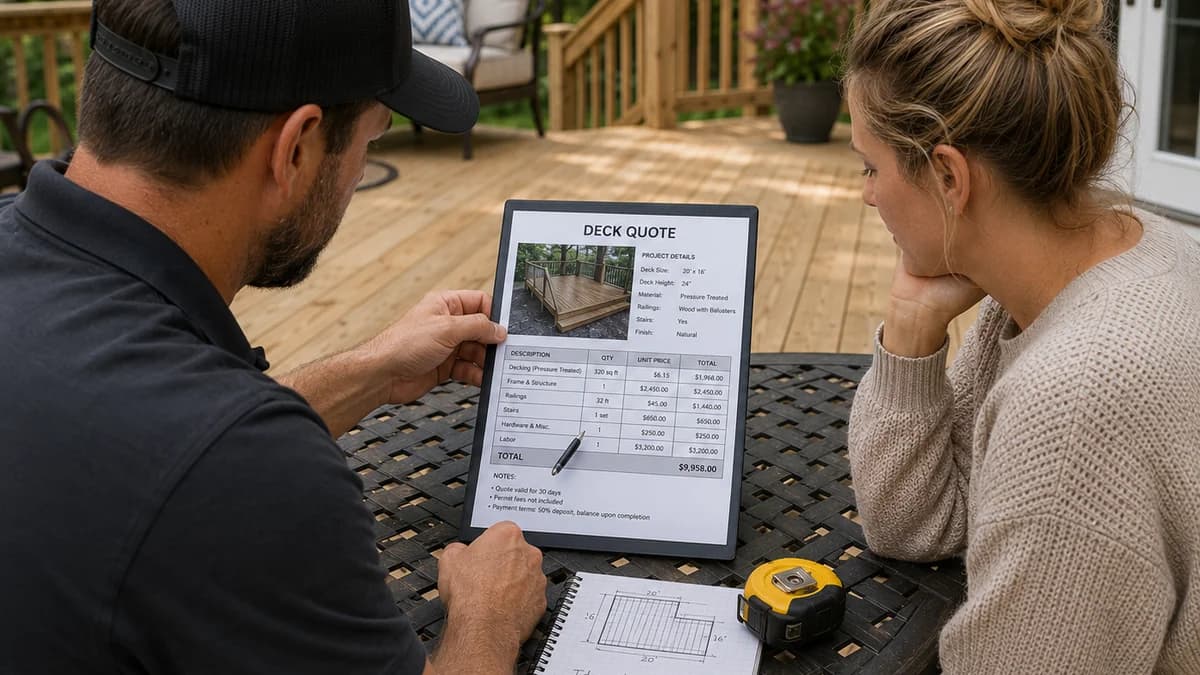
- Read what that buys before you compare it to anything: a 16 by 20 deck with a full railing, three stairs to grade, a built-in bench, and a planter. Permit not included.
- Zonda is worth quoting because it publishes its method, with a cost baseline built from BLS and BEA federal price data. The $30 to $60 bands you see elsewhere, including in an earlier version of this page, come from sites that publish no method at all.
- Per square foot is a poor unit for a deck. Railing is priced by the linear foot, stairs by the step, and footings by the hole, so height changes the price far more than area does.
- A guardrail becomes mandatory once any point within 36 inches of the deck edge is more than 30 inches above the grade below (IRC R312.1.1). Staying under that line is the biggest cost lever most homeowners never consider.
- There is no national permit fee. Some towns charge a flat $75, others a percentage of construction value. Your building department publishes yours for free.
- The Census Bureau puts the median spend on a porch, deck, patio, or terrace at $4,800, but that lumps in repairs and DIY, so treat it as perspective rather than as a build quote.
Where those two numbers come from
Zonda publishes an annual Cost vs. Value report, and for 2025 it priced two decks. A wood deck addition came to $18,263. The same deck in composite came to $25,096. Both are 320 square feet, which is where the $57 and the $78 come from.
What makes those worth quoting isn't the size of the sample, it's that Zonda shows its work. The cost baseline is built from federal data: the Bureau of Labor Statistics consumer and producer price indexes, the Bureau of Economic Analysis personal consumption expenditures index, and BLS installer wage figures. A partner firm, Verisk, layers on the local market variation. That's not a government statistic and we shouldn't dress it up as one, but it's a named organization explaining its method, which in this corner of the internet puts it in a category of one.
What that money actually buys, because this is the whole game
Here is the deck Zonda is pricing, in its own words: a 16 by 20 foot deck using "pressure-treated joists supported by 4x4-inch posts anchored to concrete piers," with deck boards "in a simple linear pattern," a "built-in bench and planter," stairs "assuming three steps to grade," and "a complete railing system." The composite version is the same deck with composite boards and a matching composite railing.
Read that list twice, because it explains why the per-square-foot numbers you see everywhere feel low. Zonda's deck has a railing all the way around, a flight of stairs, a bench, and a planter. The $30 to $60 bands quietly do not. They're pricing a platform. Zonda is pricing a deck you'd actually use. One thing even Zonda's scope never mentions is the permit, so don't assume it's in there.
Why per square foot is the wrong unit for a deck
Here's what matters more than any single figure on this page. A square-foot rate works for something that's the same all the way across, like carpet or a driveway. A deck isn't that. Most of what drives a deck's price attaches to its edges and its height, not to its area, so the rate slides around as the deck changes shape even when the square footage doesn't move at all.
- Railing is priced by the linear foot of railing, and it becomes mandatory once any point within 36 inches of the deck edge sits more than 30 inches above the grade below (IRC R312.1.1). Two decks with identical square footage, one 20 inches up and one 40 inches up, have completely different bills, and only one of them needs a guard at all.
- Stairs are priced by the step and by the run. A deck three feet up and a deck seven feet up cover the same area and are nowhere near the same job.
- Footings are priced by the hole, and how deep they go is set by your local frost line, not by how big the deck is. A small deck in Minnesota can need deeper footings than a large one in Georgia.
- The frame gets more expensive with height and with snow. Your ground snow load changes which joist and beam you are allowed to use, and a bigger member costs more per foot of deck than a smaller one covering the same ground.
- Small decks cost more per square foot than large ones, because the fixed work of mobilizing, permitting, digging, and setting up spreads across fewer feet.
So when a contractor quotes you a rate per square foot, the honest follow-up isn't whether the rate is fair. It's what the rate contains. A $30 rate that leaves the railing off and a $55 rate that includes it can be the very same price for the very same deck. That's also why two bids on the same backyard can sit thousands apart with nobody padding a thing, a fight we pick apart in why one deck quote reads so much higher than another.
Why our numbers changed, and what we got wrong
If you read this page before today, you saw a $30 to $60 band, a five-region price table, and a footings figure, all credited to named sources. We went back and checked them. Two of those sources turned out to be the same company. One was the content blog of a gardening app. One was a unit-conversion website that has never published the regional numbers we'd put beside its name. We'd also written that our figures came from a survey of more than 10,000 projects, and no such deck survey exists anywhere we could find. All of it is gone. The Zonda figures above are what replaced it, and the reason we can tell you their method is that they told us theirs.
What most homeowners actually spend
One more number is worth knowing, and this one is straight from the federal government. The Census Bureau's American Housing Survey puts the median homeowner spend on a porch, deck, patio, or terrace at $4,800, for work done between 2021 and 2023.
The caveats aren't small. That figure lumps decks in with porches and patios, it's a median across every project size including small repairs, and roughly a third of the improvement projects in that survey were done by the homeowner rather than a contractor. So it isn't a price for a new contractor-built deck, and anyone quoting it as one is misleading you. What it's genuinely good for is perspective: the typical American spending money on outdoor living space is spending far less than the cost guides imply, because most of them aren't building a 320 square foot deck with a bench and a planter on it. If your project is a modest ground-level platform, you live closer to this number than to Zonda's.
The permit, priced honestly for once
You'll see a national permit figure quoted at around $230 to $500. We used to quote it ourselves. There is no national permit figure, and there can't be, because jurisdictions don't even charge the same kind of fee.
- Johnston County, North Carolina charges a flat $75 for a deck or gazebo permit, plus $75 per trade inspection.
- Menifee, California lists a deck or patio permit at $137.35 all in.
- Washington, DC charges by valuation: $30 plus 2 percent of construction value, plus a 10 percent surcharge. On an $18,000 deck that lands near $435.
The point isn't those three towns. It's that your own building department publishes your number, for free, and finding it takes about four minutes. A range invented by a website is strictly worse than the real figure you can go and get.
What moves your number up, down, and off the chart
A range with no drivers behind it turns an honest contractor into a suspect, so here's what actually pushes a deck price around.
Up
Height, more than anything, because height drags in a guardrail, longer stairs, taller posts, and work done off ladders. After that: composite or PVC boards instead of treated pine, which is worth roughly a third of the job on its own. A cut-up shape or a diagonal board layout, which adds labor and waste together. Tearing out an old deck. A heavy ground snow load, which forces bigger framing whether you like it or not. And hard access, which is the driver homeowners forget most. A backyard with no gate wide enough to drive through means every yard of concrete and every stick of lumber arrives on somebody's shoulder, and that's paid time.
Down
Staying below the guard threshold, which is the single biggest lever almost nobody considers. A ground-level platform under 30 inches needs no code guardrail, and dropping the railing removes an entire linear-foot line item from the page. Then: a plain rectangle, boards run straight, treated pine, and an existing frame sound enough to re-deck rather than rebuild.
When the numbers on this page stop applying
They don't cover a roofed or screened deck, a rooftop deck, a second-story deck reached from inside the house, or anything built over living space below, which is waterproofing work and a different trade. They also don't cover a deck that needs engineered plans because it falls outside the prescriptive code tables, which our framing guide gets into. Any of those, and the figures here are a floor rather than a guide.
How to build a budget you can defend
Stop hunting for the rate. Build the scope, then let the quotes price it.
- 1Write down the deck: its footprint, how high it stands, and the exact board you want, by brand and line if it is composite.
- 2Decide whether a guardrail is required, using the 30-inch rule above. If it is, measure the linear feet of open edge, because that is a budget line of its own and not part of any square-foot rate.
- 3Count the stairs it takes to reach grade.
- 4Call the building department for two numbers: your permit fee and your ground snow load. Both are free, and the second one changes what framing you are allowed to use.
- 5Anchor to Zonda if your deck is full scope with a railing and stairs, and to the Census median if it is a simple ground-level platform. Most decks live somewhere between those two.
- 6Hand that written scope to every contractor and have each one price it. When the numbers come back you are comparing prices, not comparing guesses.
Got a per-foot number and want to gut-check it?
Send over your square footage, the material, the height off the ground, and the price a contractor quoted, and say whether that quote includes the railing, the stairs, and the permit. A vetted pro on TradeIQ will tell you what the rate actually covers and whether the scope behind it is complete, which is the only way a per-foot figure means anything at all. No deck of ours is headed to your yard and no contact details get resold, so nothing tilts the read.
Price your deck before the quotes come in
Tell a vetted TradeIQ deck builder your size, your material, your height off the ground, and your region, and they will tell you what a fair total looks like for the scope you actually want, including whether you need a guardrail and what that adds. No bid of their own, no lead sold, no reason to point you high.
A Written Review or a quick Phone Call both work for a pre-quote sanity check.
Get an unbiased expert reviewFrequently asked questions
- How much does a 20x20 deck cost?
- A 20 by 20 deck is 400 square feet, a quarter larger than the 320 square foot deck Zonda prices at $18,263 in wood and $25,096 in composite. Scale for the extra area and a comparable full-scope 20 by 20, meaning a railing all the way around, stairs to grade, and a proper concrete-pier foundation, lands in the low-to-mid twenty thousands in wood and past thirty thousand in composite. Treat that as an anchor, not a quote. A ground-level 20 by 20 that needs no guardrail costs dramatically less, because railing is priced by the linear foot and a deck that size has 80 feet of edge.
- Can you build a deck for $5000?
- Yes, but only a particular kind of deck. Five thousand dollars sits close to the Census Bureau's median homeowner spend on a porch, deck, patio, or terrace, which was $4,800 for work done between 2021 and 2023. What buys a deck at that price is staying simple: a ground-level platform under 30 inches, so no code guardrail is required, in treated pine, a plain rectangle, boards run straight, and often with the homeowner doing some of the labor. What will not fit in $5,000 is a raised deck with a full railing and a flight of stairs built by a contractor. The guardrail is usually what breaks the budget, so if $5,000 is your ceiling, design to stay under that 30-inch line.
- How much does a 12x12 deck cost?
- A 12 by 12 is 144 square feet, under half the 320 square foot deck Zonda prices at $18,263 in wood. Don't just take 45 percent of that, though, because small decks cost more per square foot than big ones. The permit, the footings, mobilizing a crew, and setting up are close to fixed whatever the size, so they spread across fewer feet. Expect a simple ground-level 12 by 12 in treated pine to come in well under $10,000, and a raised one with a full guardrail and stairs to run considerably more, since a 12 by 12 has 48 feet of edge to railing once it clears 30 inches.
- How much does it cost to build a 12 by 24 deck?
- A 12 by 24 deck is 288 square feet, close to the 320 square foot deck Zonda prices at $18,263 in wood and $25,096 in composite, so that report is a fair anchor. The shape is what to watch. A 12 by 24 is long and narrow, which gives it more perimeter for its area than a squarer deck, and perimeter is what railing gets priced against. If it stands high enough to need a guard, budget for 60 feet of railing rather than the 52 a 16 by 20 would need. As always, height drives more of the number than area does.
- Do decks add value to a home?
- Better than most remodeling projects, though not all of it comes back. Zonda's 2025 report found a wood deck addition recouped 94.9 percent of its cost at resale, and a composite deck addition recouped 88.5 percent. Wood beats composite there, because composite costs meaningfully more to build while adding less than proportionally to what buyers will pay. Two caveats worth holding onto: the resale side of that report comes from a survey of real estate agents estimating value, not from tracked sale prices, and no project returning under 100 percent is actually making you money. A deck is a good way to lose less than usual on something you wanted anyway.
- How much would a 20x20 composite deck cost?
- Zonda prices a 320 square foot composite deck addition at $25,096, including a matching composite railing system, three stairs to grade, and a built-in bench and planter. A 20 by 20 is 400 square feet, a quarter larger, so a comparable full-scope build reasonably lands north of thirty thousand dollars. The composite premium is real: the identical deck in wood comes in at $18,263, so choosing composite adds roughly a third to the bill. What you buy for it is boards that never need staining or sealing. What you give up, on that same report, is resale return, since the composite deck recoups 88.5 percent against wood's 94.9.