Questions to Ask a Concrete Contractor
Published by TradeIQ · Updated
Every trade you hire comes with a rulebook somebody else wrote, and somebody else already made it stick. A shingle maker's nailing spec is a warranty condition. The electrical code is law in your town whether anybody likes it or not. Concrete has a rulebook too, and it says in plain numbers how wide a crack has to get before it counts as a defect. What concrete doesn't have is anybody making your contractor follow it. So the questions to ask a concrete contractor aren't really about judging the man in your driveway. They're about getting a rulebook that already exists to apply to you. Because that book isn't law, and your driveway isn't covered by the codes that would make it law, so unless your contract reaches out and names it, the crack you're staring at in year three is governed by nothing at all.
Key takeaways
- A published crack threshold does exist. The National Association of Home Builders puts driveway and sidewalk cracks at 1/4 inch and interior slab cracks at 3/16 inch in its Residential Construction Performance Guidelines, and arbitrators use it. It is just not binding on your job unless your contract names it.
- Some states make it law for new houses. New Jersey codes a quarter inch on basement, garage, and attached patio slabs. A driveway on the house you already own falls outside all of that.
- So make it binding: name the guidelines in the contract and write down the crack width that triggers a repair, plus the timeframe and the remedy.
- Ask how the concrete reaches the forms, then get the answer written into the contract as chute, pump, or wheelbarrows, with the pump and operator priced on their own line if that's the plan.
- Ask for the ready mix delivery ticket. ASTM C94 has the plant furnish one with every load, and it is the only document on the job from someone who does not work for your contractor.
- Flatwork rides workers comp class code 5221, not 5213. Rates vary by state, carrier, and his claims history, but the premium is real, and my guys are 1099 so we don't carry comp means the risk just moved to your house.
The crack threshold exists. Nobody is bound by it.
Start here, because it changes what every other question on this page is for.
Your slab is going to crack. Fine shrinkage cracking is what healthy concrete does as it cures, and the American Concrete Institute has said flatly, in print, that you can't design it out. So the argument you'll actually have someday isn't whether there's a crack. It's where normal ends and failure begins.
There's a published answer, and most homeowners never hear about it. The National Association of Home Builders puts out the Residential Construction Performance Guidelines, sells it as a consumer reference, and it's the book that gets pulled out in home warranty arbitration. It draws the line in plain numbers:
- On a concrete floor slab, the guidelines call minor cracks normal, and say a crack wider than 3/16 of an inch, or displaced vertically by 3/16 of an inch, gets repaired if the slab is in conditioned space or the crack gets in the way of finish flooring.
- On driveways and sidewalks, outside of the control joints, the number moves to 1/4 of an inch of width or 1/4 of an inch of vertical displacement. Past that, it gets repaired.
Some states go further and write it into law for new houses. New Jersey's new home warranty code sets the deficiency at cracks over a quarter inch in a basement, garage, or attached patio slab, calls a crack of an eighth inch or more in a foundation wall excessive, and allows only hairline cracking under an eighth of an inch on stoops and steps. That's a state administrative code, not a suggestion.
Now the catch, and it's the whole reason this page exists. None of that binds the man pouring your driveway. The builders' guidelines are a private document with no force unless a contract adopts them. The state warranty codes cover new home construction, so a standalone driveway or patio on a house you already live in falls outside them entirely. And the engineering standard people reach for instead, the concrete institute's tolerable crack widths for reinforced structural concrete, is durability guidance for beams and walls under load. It was never written to tell a homeowner whether his patio is acceptable, and using it that way is a category error.
So the book is real, it's specific, and it's sitting on a shelf with your name nowhere on it. Which gives you something to do that almost nobody does: get the Residential Construction Performance Guidelines named in your contract by name, and get a crack width written down that triggers a repair. Do that and you have a rulebook. Skip it and you're quoting a book your contractor never agreed to, to a man who doesn't have to care.
The eight answers that have to end up on paper
Ask each of these out loud and listen for one thing: does a number come out of his mouth. That's the entire test. A number can go into a contract. An adjective cannot.
What PSI are you ordering, and will you leave me the ticket?
Ready mix doesn't arrive anonymously. ASTM C94, the specification that governs ready mixed concrete, has the plant furnish a delivery ticket with every load, showing what was batched, how many yards came off the drum, and the time. That ticket is the only piece of paper generated on your whole job by somebody who doesn't work for your contractor. Ask for it while you're still deciding, and ask him to leave it in your hand on pour day.
- A good answer: he names the PSI he's ordering, tells you whether the mix is air entrained for your winters, and says of course you can keep the ticket.
- A bad answer: he meets a spec question with a mixing ratio, so many parts gravel to sand to cement. That's a recipe for a wheelbarrow. It says he isn't picturing a phone call to a batch plant, and your driveway is not getting stirred up in a bucket.
Hold on to the ticket, because the yardage on it is a receipt. Your slab is a known size and he sold you a known thickness, so the concrete that showed up either adds up or it doesn't, and somebody who does this for a living can run that check in about ten seconds.
What size bar, how far apart, and what is holding it off the dirt?
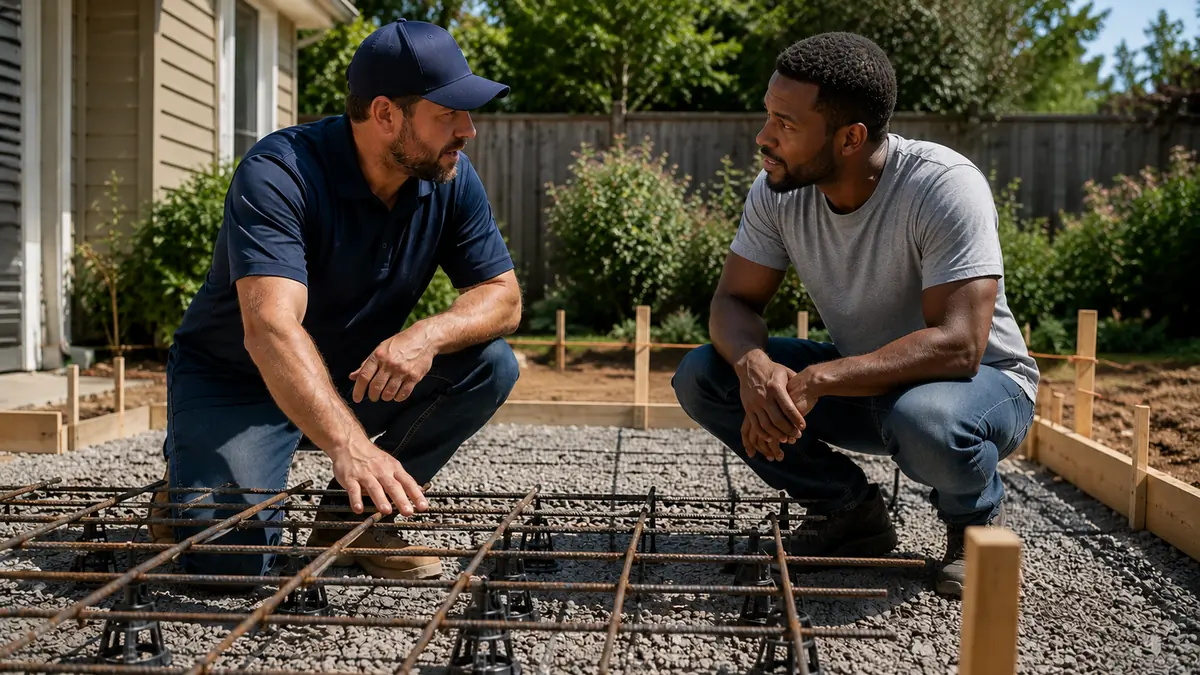
Steel only works if it ends up inside the slab. Laid straight on the ground and poured over, it sits at the very bottom in the dirt, doing close to nothing, and you paid for it just the same. The little plastic or wire stands that hold it at the right height are called chairs. They cost almost nothing. Whether he uses them is a wonderful question precisely because homeowners never ask it, so the answer hasn't been rehearsed.
- A good answer: a bar size, a spacing in inches, and the word chairs, offered without you having to prompt for it.
- A bad answer: we throw some mesh in there. Mesh rolled out on dirt and buried under wet concrete stays on the dirt. That's reinforcement on the invoice and nowhere else.
What is going under the slab, and in how many lifts?
A lift is a layer. A machine can't compact a deep pile of stone all the way through in one pass, so a crew that knows what it's doing puts the base down a few inches at a time and runs a plate compactor over each layer before adding the next. Asking how many lifts is a fast way to find out whether anybody has thought about it.
- A good answer: crushed stone, a compacted depth in inches, a count of lifts, and a plate compactor. Four specifics, no hesitation.
- A bad answer: the ground here is solid, we'll pour right over what's there. Grass, topsoil, and whatever the last owner buried out back are not a base.
How does the mud reach the pour?
Almost nobody asks this, and on a back yard job it swings more of your bill than the mix spec does. Ready mix has to be placed within a set time or it's scrap, so the whole plan lives or dies on how far it has to travel once it leaves the drum. A pour the driver can serve straight off the chute is easy. A pour behind a house, up a slope, or through a 36 inch gate is a different animal: he's renting a pump and an operator for the day, or he's putting bodies on buggies and wheelbarrows and racing a mix that's already stiffening.
Ask it, and then make him write the answer down. Chute, pump, or wheelbarrows, with the pump and the operator priced as their own line if that's the plan. A placement method sitting in the contract is a placement method he can't reprice at seven in the morning while the driver waits.
- A good answer: he has already walked around the back, measured the gate, and says flat out whether this is a chute pour, a pump pour, or a wheelbarrow pour, and what that adds.
- A bad answer: we'll sort it out on the day. That's a change order with a fuse on it, and it lights while a loaded truck idles in your street on the clock.
What has to come out before anything goes in?
If something is already sitting where your new slab goes, it has to leave first, and that's its own job with its own machine, its own crew, and its own disposal bill. Landfills charge by weight, and cured concrete is about as heavy as debris gets. Excavated dirt works the same way. It gets spread somewhere on your lot for nothing, or it rides out on a truck for money, and only one of those two is in his price.
What you want out of this question is a line item, not a reassurance. Demolition, haul-off, and disposal, each named in the contract, with a dollar figure and the word included or the word excluded next to it. Whichever word he picks, you now know before you sign.
- A good answer: he names what gets broken out, says who is hauling it, tells you whether a dumpster is coming, and puts disposal on the estimate as a separate line with a dollar figure beside it.
- A bad answer: silence, or we'll take care of that for you. Neither one is a line item, and neither one is going to hold up when the dump scale prints a ticket.
What happens after you leave?
Most of the work on this list vanishes the moment it's finished. This one is the exception, and it's the step crews skip most often, because it lands after the interesting part is over.
Concrete doesn't dry. It cures, through a reaction that needs water to keep running, and it keeps running long after the surface stops looking wet. Curing is simply the crew keeping that water in the slab: wetting it down, covering it, or spraying a curing compound over the top. Plan on roughly a week of that. The clock stretches in cold weather, because the reaction slows down when the temperature drops, and it takes 28 days for concrete to reach its full design strength, which is the number that matters if an RV or a loaded truck is going on it.
- A good answer: he names the method, says about seven days, and tells you to walk on it after a day and keep the car off it for a week.
- A bad answer: once it looks dry you're fine. The surface looks dry long before the slab is finished, and that sentence means he's planning to be somewhere else.
Write his curing answer down, because this is the one promise on the whole job you can personally watch him keep.
Who is pulling the permit?
Only one answer here does you any good, and it's a short one. In concrete, though, this question quietly does a second job, and that's the part worth knowing.
A contractor who steers the permit toward you is doing two things at once. He's moving liability off his business and onto your name, and very often he's doing it because he can't pull it himself: the permit counter wants a license he doesn't hold. So this is how you learn about his licensing without ever asking him about his licensing. Ask it early and ask it flat.
- A good answer: we pull it, it's in the price, and here is which inspections your job gets.
- A bad answer: any version of it is easier if you pull it as the homeowner, or you don't need one for something like this.
What crack are you coming back for?
This is the question the whole page was built around, and nearly nobody asks it. Don't ask whether he warranties his work. Everybody warranties their work. Ask him what he warranties it against, and then hand him the number.
You aren't making it up. The home builders' guidelines already put a driveway or sidewalk crack at a quarter inch and a slab crack in living space at three sixteenths. Say those out loud, name the book, and ask him whether he'll stand behind that line. Then get the rest: how long after the pour, and what he actually does when a crack goes past it. Grind it, fill it, saw the panel out and repour it, or explain to you why it's fine.
- A good answer: a width, a timeframe, and a remedy, all three of which he is willing to see typed into the contract. He'll also say plainly that fine shrinkage cracking is normal and he isn't coming back for it, which is honest and correct.
- A bad answer: we warranty our workmanship for a year. Against what? A one year warranty with no defined defect is a warranty against nothing, and you'll both find that out in year two.
Make the book apply to your slab
The line already exists. Getting a contractor to sign up to it, in language that will still mean something in year three, is the part homeowners have no practice at, and it can only be done in the days before work starts. Once the forms go in, the terms are the terms. Send the quote and whatever warranty language you were handed to a veteran concrete pro on TradeIQ while the agreement is still unsigned, and get it back with the wording a contractor will actually put his name on.
The license, and the one sentence on it worth reading
Don't ask whether he's licensed. Get his license number, then go run it yourself through the license lookup your state contractor board publishes. Every board that licenses this trade has one, they're free, and they take about a minute. Then read the part everybody scrolls past.
Concrete is regulated with more variation than most trades. Some states give it a classification of its own. California is the clean example: its contractor board issues a C-8 Concrete Contractor license, and here is exactly how the state defines it.
California's C-8 Concrete Contractor classification, in the state's own words
"A concrete contractor forms, pours, places, finishes and installs specified mass, pavement, flat and other concrete work; and places and sets screeds for pavements or flatwork."
Read that as a list of verbs, because that's what it is. It draws the fence line around what the state has cleared him to do, and the same regulation carves out the guys who only do plaster or only place rebar. Texas sits at the far other end and licenses concrete nowhere statewide, which leaves the question to your city or county to answer however it likes. Most states land somewhere in between.
The move that travels: get his number, run the search, confirm the license is active, then read the scope printed beside it. The status line is the bit everyone checks. The scope line is the bit that decides whether he's allowed to pour your driveway at all.
Concrete is priced like dangerous work
Insurers put a dollar figure on how likely a trade is to hurt somebody, and flatwork has a class code all its own. Code 5221 is the one that covers concrete and cement work on floors, driveways, yards, and sidewalks, which is your job. It isn't code 5213, which is the elevated, self bearing structural concrete of commercial buildings, and a contractor or an agent who quotes you the wrong one isn't describing the work he's doing in your yard.
What that coverage costs is not a national number and anybody who prints one is guessing. Comp rates swing hard by state, by carrier, and by the contractor's own claims history, which follows him around as an experience modifier. What is not in doubt is the direction. Wet concrete is heavy, it burns skin, the tools are fast, and the pour doesn't slow down for anyone, so the insurance market prices this trade high and the premium is a real line in his overhead.
Which means you now know what's being saved when the coverage is missing. That's the context for a line you'll hear on somebody's tailgate: my guys are all 1099, so we don't carry comp. That isn't a paperwork quirk. It's a bill being moved. If a man tears something carrying a bull float across your yard and there's no policy standing behind him, the search for someone to pay for it starts at the property he was standing on, and that's your house.
So handle it the same way you handle everything else on this page: with paper, before work starts. Get the certificate of insurance straight from his agent, not a photo of one off his phone. Check the dates, because a certificate that expired in March is a piece of scenery. Look at the workers' comp row specifically and make sure a real policy number is sitting there, not a blank and not the word exempt while a four man crew unloads tools in your driveway. Then read the general liability row and see that the described operations actually sound like flatwork. Any limit on that row is a number his carrier and his own risk picked, and there's no legal figure it has to hit, so what you're checking is that a live policy exists and that it covers the work he's about to do at your house.
The deposit is capped. The lien is not.
A few states set a legal maximum on what anybody may collect from you before a shovel moves. A residential slab sits inside the home improvement rules, so wherever a maximum exists, it reaches your pour.
California writes it into its Business and Professions Code, at 7159.5, where a downpayment "shall not exceed one thousand dollars ($1,000) or 10 percent of the contract price, whichever is less." Read the scope before you wave it at anyone. It's a home improvement rule and it doesn't reach new construction. It also lifts entirely for a bonded contractor, meaning one carrying a performance bond and a payment bond, or one working under a joint control the board has approved. So a request above the cap isn't automatically improper.
Nevada holds residential improvement work to the same shape under NRS 624.970, which since October 2023 has limited the initial deposit on an owner occupied single family home to $1,000 or 10 percent of the total contract price, whichever is smaller. It has its own escape hatch too: file a consumer bond of $100,000 and the cap stops applying.
Most states set no maximum whatever, so go find out what yours does before you write a check, instead of trusting a number recited across your kitchen table.
The bill that arrives even though you paid
Here's what none of those limits touch. The concrete on your driveway didn't come from your contractor. It came from a batch plant that delivered thousands of dollars of material to your address, on his account, on credit. If he never settles up with them, that plant can file a lien against your property. In most states you can have paid every invoice he sent you, on time and in cleared funds, and still get liened by a supplier you never met and never hired. It isn't every state. Some of them limit an owner's exposure to whatever is still unpaid on the contract, so how badly this can bite you depends on where you live.
The deposit cap guards the money going out of your hand. It does nothing about a bill walking in the door behind it.
The defense is lien waivers signed by everyone with a claim on the job: conditional waivers as each progress payment goes out, final waivers when the work is done, from your contractor and from the ready mix supplier. Which puts one more line on your list of questions. Ask him which plant he's ordering from. A real concrete contractor answers instantly, because he has an account there and he knows the dispatcher by name. Get that plant written into the contract, so the waiver you need at the end has a name and an address to come from.
The paper is the only witness
None of this is about catching a liar. Most concrete contractors are honest and plenty of them are excellent, and the good ones will enjoy these questions, because being asked about chairs and lifts and curing is the closest thing to respect this trade gets from a homeowner.
It's about what still exists in year three. The slab can't speak for you. No inspector comes back to measure anything. The standard is real, but it's printed in a book that will sit on a shelf unless your contract reaches out and picks it up. So ask the eight questions, write down exactly what he says, name the guidelines and the crack width in the agreement, and put his own answers in front of him before you sign. That's how a rulebook somebody else wrote finally becomes yours.
Get the standard into your contract while it can still go in
The crack width that decides your argument is published, and it's worth nothing to you until it's typed into an agreement your contractor signed. That window shuts the day work starts, and it doesn't reopen. Send a veteran concrete pro on TradeIQ your quote and the answers you wrote down while the contract is still a draft, and find out what a contractor will really agree to stand behind.
Written Review
Get an unbiased expert reviewFrequently asked questions
- What are good questions to ask a contractor?
- The good ones all share a shape: the answer is a number. For concrete, ask what PSI he's ordering and whether the mix is air entrained, what size the rebar is and how far apart it sits, what is holding that steel up off the dirt, how deep the compacted base runs and in how many lifts, how the mud is going to reach the pour, what gets demolished first and who eats the disposal bill, how he's curing the slab and for how long, who is pulling the permit, and what crack width he will actually come back for. Then listen for whether figures come out of his mouth. The man who has genuinely thought your slab through will answer in numbers. The one who hasn't will answer in adjectives, and an adjective can't go into a contract.
- How to choose a good concrete contractor?
- Choose on paper, not on the estimate visit. Run his license number through the lookup your state contractor board publishes, and read the scope printed beside it, not just whether the status says active. Get the certificate of insurance and check that the workers' comp row holds a real policy number. Then ask the spec questions and write the answers down, because the answers are the point: the PSI, the bar size and spacing, the base depth and lifts, how the mud reaches the forms, the curing plan, and the crack width he will honor. Hand those back to him as part of the contract. The contractor worth choosing is the one willing to sign his own answers.
- What is the warranty on concrete?
- There are two things being run together here. The first is the contractor's own workmanship warranty, and its length is whatever he decides to offer, because no law sets it. It stretches with the size of the job, with how established the outfit is, and with whether he thinks you'll walk without one, and it shrinks to nothing at all with a crew that plans to be somewhere else next spring. The second is the standard it gets measured against, and that one exists but doesn't automatically apply to you. The National Association of Home Builders publishes crack thresholds in its Residential Construction Performance Guidelines: past 1/4 inch on a driveway or sidewalk outside the joints, past 3/16 inch on a slab in living space, it gets repaired. Some states, New Jersey among them, code similar numbers into their new home warranty law. But that book isn't law, and those state codes cover new home construction, so a driveway poured at an existing house is governed by your contract and nothing else. So we warranty our work, on its own, is close to meaningless, and so is a number of years with no defect attached to it. What makes it real is naming the guidelines in the agreement and writing down a crack width, a timeframe, and a remedy. Fine shrinkage cracking is normal and no honest contractor will warranty against it.
- What happens if you pour a concrete pad without a permit?
- That is set locally, by your city or county, which is the honest answer and also the uncomfortable one: you won't learn what your consequences are until somebody comes looking. It tends to surface twice, once if an inspector notices and again when you sell and the buyer's side starts asking whether your improvements were permitted. But the more useful thing here is what the permit question tells you about the man. A contractor who pushes the permit onto you as the homeowner is moving liability onto your name, and he's often doing it because the counter wants a license he doesn't hold. Ask whether the job needs a permit and who is pulling it. The answer you want is two words long.
- How long does concrete need to cure before putting weight on it?
- The working rule most crews go by: you can walk on a fresh slab after about a day, and you can drive a car onto it after about seven. Curing isn't the same as drying. The slab keeps gaining strength through a reaction that needs water in it, which is why a good crew keeps it damp or sprays a curing compound over the top and leaves it alone for roughly a week. Cold weather stretches every one of those numbers, because the reaction slows as the temperature falls. And full design strength lands at 28 days, which is the figure that matters before an RV, a loaded truck, or a dumpster goes on it. Get both dates out of any bidder, when you can walk and when you can drive, and ask what he's doing to hold the moisture in. If the answer is that you're fine once it looks dry, he has told you he plans to be gone by then.
- What happens if you don't let concrete cure?
- The surface pays for it. Concrete gains strength through a reaction that needs water, so a slab left to dry out fast in sun and wind never gets everything it was ordered to have, and the top is where that shows up. The top is also the only layer your feet and your tires ever touch. What makes this worth asking about is the economics: curing costs almost nothing next to everything else on the quote, it's the last thing on the job, and it lands after the crew has already done the work they enjoy. That is exactly why it gets skipped, and it's why a contractor who volunteers his curing plan before you ask has told you something real about how he runs a job.