How to Cut Fiber Cement (Hardie) Siding Safely
Published by TradeIQ · Updated
Cutting Hardie board is not really a question about getting a clean edge. It is a question about what you breathe while you get it. Fiber cement is up to 45% crystalline silica by weight, and OSHA says the dust causes silicosis, lung cancer, COPD, and kidney disease. The methods below are ordered by how much dust they put in your air, and the quietest one is a scoring knife and a straightedge rather than a saw. But there is one question that comes before all of them, and no tool on your bench can answer it.
Key takeaways
- Cementitious siding on a pre-1980 house may be asbestos-cement, which looks like fiber cement. You cannot tell by eye, and EPA says to let a trained professional take any sample rather than doing it yourself. Never saw it to find out.
- James Hardie's current safety data sheet puts crystalline silica at 15 to 45% by weight of an exterior board, and 15 to 30% of HardieBacker.
- OSHA does not hedge: the dust causes silicosis, lung cancer, COPD, and kidney disease, and OSHA found significant risk remains even at the legal limit.
- A tight-fitting respirator seals against bare skin, so hair crossing the seal lets dusty air leak past the filter. A loose-fitting powered hood does not depend on that seal at all.
- OSHA's "no respirator needed" entry applies only to a handheld saw with a blade 8 inches or under, outdoors, with a 99%-efficient dust collector. A miter saw puts you outside it.
- Never dry-sweep the dust, and do not blow it off with compressed air or a leaf blower. OSHA restricts dry sweeping and compressed air for employers unless nothing else is workable, and Hardie's own sheet says never dry sweep, in capitals.
First: is that board fiber cement, or is it asbestos-cement?
Is the house older than about 1980, and does it already wear a hard, grey, cementy siding or shingle? Then stop. Cement siding of that era was often asbestos-cement, and it looks very much like modern fiber cement. You cannot tell them apart by eye, and EPA says the same: generally you cannot tell whether a material contains asbestos simply by looking at it, so if you are in doubt, treat it as though it does and leave it alone. And sawing is exactly the wrong move, because EPA defines cutting to include sawing, and sawing is what turns intact asbestos-cement into the powder that is the dangerous form. EPA tells homeowners plainly: do not saw, sand, scrape, or drill holes in asbestos-containing materials. Nothing else on this page applies to that board. A respirator and a shop vacuum are not an asbestos plan. And do not go at it with a chisel to get yourself a sample either. EPA puts that job with a trained, accredited professional rather than the homeowner, precisely because a sample taken badly can release more fiber than the intact board ever would. If it comes back positive, the next call is a trained, accredited asbestos professional rather than a siding crew. EPA describes two routes from there, repair and removal, and repair can mean sealing or covering the material instead of tearing it off. Which one fits depends on the condition of the board and how much your project would disturb it, and that is their call rather than ours.
Now, assuming you are cutting new board. James Hardie's current safety data sheet for its exterior boards names two ingredients and no others: crystalline silica, and carbon black at under one percent. Asbestos is not among them. Quartz is, and quartz is why this page had to be written.
What the dust actually is, in the manufacturer's own numbers
James Hardie publishes a safety data sheet covering its exterior boards, and the ingredient line reads: crystalline silica (quartz), 15 to 45% by weight. That one sheet spans HardiePlank lap siding, HardiePanel, HardieSoffit, HardieShingle and the 7/16 inch HardieTrim, so it almost certainly covers the plank in your hands. HardieBacker, the interior backer board, has its own sheet at 15 to 30%. So somewhere between a seventh and nearly half of that plank is the same quartz that is in sand. Dry-cut it with a high-tooth blade and you are not making chips. You are grinding quartz into particles fine enough to ride deep into your lungs and stay. That is the tradeoff you are actually making, and it is worth knowing before you pick fiber cement at all.
Here is where we are going to quote OSHA rather than soften it, because OSHA does not soften it. The agency does not say the dust is linked to disease or associated with it. It says respirable crystalline silica causes silicosis, an incurable lung disease that leads to disability and death, and that it also causes lung cancer, chronic obstructive pulmonary disease, and kidney disease. The International Agency for Research on Cancer puts crystalline silica in Group 1, carcinogenic to humans, which is its top category. The National Toxicology Program calls it a known human carcinogen.
And when OSHA set the legal workplace limit, its own risk assessment for the 2016 rule concluded that significant risk remains at that limit, 50 micrograms per cubic meter averaged over an eight hour day. That finding sits in the preamble to the rule rather than in the regulation, so reading the standard alone will not show it to you. The number is the lowest level the agency judged feasible for industry as a whole, not a level it thinks is safe. That is worth sitting with. The legal limit is not a safe dose. It is a compromise. You are not bound by it anyway, which we will get to, and which cuts the other way from how it sounds.
The cutting methods, quietest first
One honest note before the list, because we would rather be useful than authoritative. Hardie publishes its own ranking for cutting outdoors, and it does not match ours. Hardie's "Best" is a circular saw fitted with a HardieBlade and an attached vacuum, with shears named on the same line as an alternative. Its "Better" and "Good" are that same saw with less dust collection. Score-and-snap does not appear in the outdoor ranking at all.
We are going to tell you something different, and tell you it is us saying it. If a cut can be made without a motor, make it without a motor. Hardie is writing for a crew that has to hang a house in two days, where a saw and a vacuum is the fastest thing that is also clean. You are not that crew. You have time, and the cut that makes no dust cannot hurt you no matter how the vacuum is behaving. Take the slow tool. That is our advice, not the manufacturer's, and you should know which is which.
Score and snap
This is the method Hardie itself prescribes for cutting indoors, where it flatly prohibits power saws. Three steps:
- 1Lay a straightedge along your cut line and run a carbide-tipped scoring knife against it several times, until you have a groove rather than a scratch.
- 2Move the board so the groove sits over an edge, groove side up.
- 3Press down on the overhang. The board breaks along the line.
No blade spinning, no motor, next to no dust. It does straight cuts, so for trimming plank to length, which is most of the cuts on most walls, it is hard to beat. Two things before you lean on it. Hardie puts the same thickness limit on this as it does on shears, saying neither is recommended for products thicker than 7/16 of an inch, so check what you actually bought. And the low dust is the reason to pick it, not a licence to skip the mask: Hardie's safety sheet asks for a NIOSH-approved respirator when you cut its board and carves out no exception for scoring, and neither will we.
Fiber cement shears
Shears bite through the board with a cutting head instead of a spinning blade, so there is no cloud, and they handle gentle curves and cutouts that score-and-snap cannot. Manual, electric, and pneumatic versions all exist. They are what a lot of pros reach for on a whole house, because they are fast and clean at the same time. Two limits: the edge is rougher than a saw cut, and Hardie states the thickness ceiling outright, saying shears are not recommended for products thicker than 7/16 of an inch. Check your plank before you buy the tool.
If you have to use a saw
Some cuts genuinely need one: crisp notches, angled ends, a lot of board in a little time. When that is you, every part of the setup exists to keep the dust out of the air and out of you.
Blade choice: diameter beats tooth count
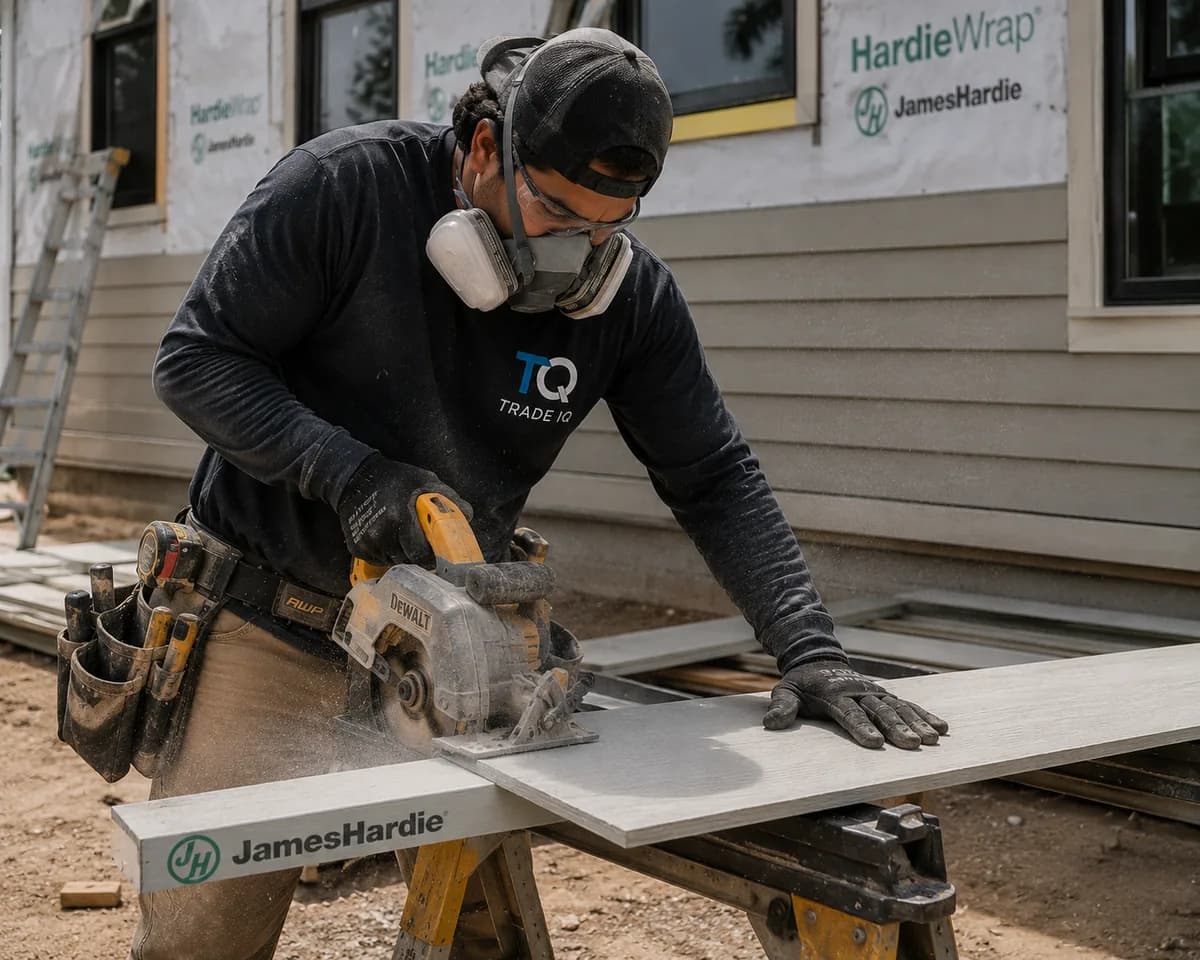
Use a blade built for fiber cement, tipped with polycrystalline diamond. The one you will be pointed at is the HardieBlade, and Diablo makes it, not James Hardie. Hardie endorses it: its own install instructions recommend a HardieBlade for best performance when you are cutting with a circular saw. Notice how few teeth it has. Diablo lists four teeth on the 7-1/4 inch blade, where a wood blade carries 24 or more. Fewer teeth shear the board off in bigger, heavier chips instead of grinding it to powder, so the same cut throws far less breathable dust.
Now the part that counts for more than the tooth count, and that we got wrong ourselves until somebody sat down with the actual rule. The HardieBlade is also sold in 10 inch and 12 inch sizes, for miter saws. If you reach for one of those, you have just walked outside the only legal shelter this job has, and you will see why in a moment. Stay at 7-1/4 inches and a handheld saw.
Dust collection, and why a shop vac is not enough
Use a saw with a dust-collection port and hook it to a vacuum with a true HEPA filter. OSHA's silica rule defines HEPA by name: a filter at least 99.97% efficient at removing particles of 0.3 micrometers. An ordinary shop vac is not rated for particles that fine, so silica can pass straight through the filter and blow back out around you, which buys you nothing and spreads the dust further than the cut would have. Cut outdoors, and stand so any breeze carries the dust away from your face. Hardie prohibits power-sawing its board indoors altogether. Not discourages. Prohibits.
The respirator, and the exemption that is not what it looks like
When a saw is running, wear a respirator. A NIOSH-approved N95 is the floor. Because you have no way to measure how much dust is actually in your air, the safer call for a homeowner is a P100 filter on a half-face respirator, which catches 99.97% of particles instead of 95%. Do not confuse either with a paper nuisance mask from the paint aisle. Those do nothing for silica.
One catch that surprises people: a tight-fitting respirator seals against bare skin, so hair crossing that seal breaks it. Nobody is being fussy about your beard for its own sake, and it is why OSHA forbids employers from letting workers wear one with facial hair that crosses the sealing surface. Stubble or a beard lets dusty air leak in around the edge no matter how good the filter is. If you have a beard you will not shave, the option that still works is a loose-fitting powered respirator with a hood, which does not depend on a face seal at all.
Now, the thing you will read on other sites, stated more carefully than they state it. OSHA's silica rule has a table of tasks, and the fiber cement entry does say that no respirator is required, for any length of shift. We used to repeat that. What we left out is the fine print, and the fine print is the whole thing. That entry only applies to a handheld power saw with a blade of 8 inches or less, used outdoors only, with a commercially available dust collection system, whose filter is at least 99% efficient, moving the airflow the tool maker specifies, with the tool operated per the manufacturer's instructions. The rule elsewhere says an employer has to fully and properly implement all of it to get the benefit.
Read that list again and count how many ways a Saturday project falls out of it. A 10 inch miter saw. A shop vac instead of a HEPA unit. Cutting in the garage because it is raining. Miss any of those and the exemption is simply gone. This is not a rule that says fiber cement is safe to cut barefaced. It is a rule that says a professional crew, doing one specific thing with one specific set of controls, has done enough. So we say what we said before, and now we can say why: wear the respirator.
Why none of this is legally required of you, and why that changes nothing
Here is the honest part, and we would rather you hear it from us than discover it later and wonder what else we shaded. OSHA regulates occupational exposure. It binds employers who have employees. A homeowner cutting siding on their own house has neither, so the silica rule does not reach you. Nobody is going to cite you for dry-cutting Hardie in your driveway with a bare face.
Your lungs do not check your employment status. The dust does the same thing to a Saturday DIYer that it does to a framer who breathes it every week, and the disease it causes has no cure and a latency measured in decades, so nothing about the day you cut will tell you whether you got away with it. The whole reason to borrow a professional crew's controls is that the law protecting them was written from what happens to people who skip them. You get the protection for the price of a respirator, and nobody is making you.
Cleanup, which is where most people undo the rest
The dust does not disappear when the saw stops, and the two most natural ways to clean it up are the two that put it straight back in your air. Do not sweep it with a broom, and do not blow it off with a leaf blower or an air compressor. This is not fussiness. OSHA's silica rule forbids employers from allowing dry sweeping or dry brushing where it could raise silica exposure, unless wet sweeping or HEPA vacuuming is not feasible, and it puts the same kind of bar on using compressed air to clean clothing or surfaces. Standing in your own yard with a hose and a vacuum, neither exception is yours. Hardie's own safety sheet says it in capitals: never dry sweep. Wet the debris down with a fine mist and wipe it up, or run the HEPA vacuum over it. Then wash the clothes you cut in, separately.
Get your setup checked before you cut, not after
Show a working siding installer your saw, your vacuum, and the respirator you bought, and they will tell you whether the three of them actually work together, and whether that mask seals on your face. They are not bidding on your house, so there is nothing riding on the answer except your lungs.
A Video Call fits this one, because what needs looking at is the bench: the saw, the vacuum, and whether that mask actually seals.
Get an unbiased expert reviewFrequently asked questions
- What can I use to cut fiber cement siding?
- For straight cuts, a carbide-tipped scoring knife: score the line several times against a straightedge and snap the board. It makes almost no dust and needs no other gear. For cutouts and curves, fiber cement shears, though Hardie says not to use them above 7/16 of an inch thick. For notches and angles that need a saw, use a handheld circular saw with a fiber-cement blade and an attached HEPA vacuum, work outdoors, and wear a respirator. And before any of it, if the board is old, find out whether it is asbestos-cement first.
- What blade is used to cut fiber cement siding?
- A polycrystalline diamond blade made for fiber cement, such as the HardieBlade, which Diablo makes and James Hardie endorses. It carries four teeth on a 7-1/4 inch blade against 24 or more on a wood blade. Fewer teeth shear the board into chips rather than grinding it to powder, so it throws far less breathable dust and lasts much longer on an abrasive material. One warning: the same line runs to 10 and 12 inch miter-saw sizes, at six and eight teeth, and OSHA's no-respirator-needed provision for fiber cement only covers blades of 8 inches or less. Going bigger quietly takes away the shelter.
- How to cut fiber cement board without a saw?
- Two ways, both low-dust. Score and snap: run a carbide scoring knife along a straightedge several times, then bend the board over an edge until it breaks along the line. Works for any straight cut. Or fiber cement shears, manual, electric, or pneumatic, which cut with a head instead of a spinning blade and handle curves and cutouts. Both avoid the silica cloud a saw makes. This is also what James Hardie tells you to do when you have to cut indoors, because it prohibits running a power saw on its board inside.
- What was the main problem with fiber cement board siding?
- For the homeowner living with it, very little. The problem is in the installing, and specifically in the cutting: an exterior board is 15 to 45% crystalline silica by James Hardie's own safety data sheet, and OSHA says that dust causes silicosis, lung cancer, COPD, and kidney disease. There is a second problem people confuse with the first. Cement-based siding made before roughly 1980 often contained asbestos rather than cellulose, and it is visually almost identical. That older board is a different hazard entirely, and telling them apart is a job for a trained, accredited professional and a lab, not for a saw.